
The cheeks play an important role in facial structure, volume, and overall appearance. Full, well supported cheeks can contribute to youthful facial proportions, while loss of volume and tissue support can gradually cause the cheeks to appear flatter, lower, or less defined.
Sagging cheeks are a common concern associated with facial aging, but age is not the only factor. Genetics, significant weight changes, sun exposure, declining skin elasticity, and changes in facial fat distribution can all influence how the cheeks change over time.
For people who feel that their cheeks have become less defined or that their face looks tired despite feeling healthy, modern facial rejuvenation treatments may offer several options. The appropriate approach depends on whether the primary concern is volume loss, loose skin, downward tissue movement, or a combination of these factors.
With more than 40 years of experience in aesthetic and reconstructive plastic surgery, Dr. Mohan Rangaswamy takes an individualized approach to facial rejuvenation. His focus is on restoring facial balance while preserving the natural character and expression of each patient.
What Causes Sagging Cheeks?
Sagging cheeks usually develop because of several changes occurring simultaneously within the face.
Natural Aging
One of the most significant factors is the natural aging process. As we age, the production of collagen and elastin gradually decreases. These proteins help provide the skin with firmness and elasticity.
At the same time, facial tissues can become less supported, allowing the cheeks to gradually descend. The result may be a flatter midface, less prominent cheek contours, and increased heaviness around the lower face.
Facial Volume Loss
Facial fat is not simply lost uniformly as we age. Different fat compartments can shrink, shift, or change in position.
When volume decreases in the cheeks, the midface can appear less full. This can make the face look older and may make the surrounding folds and contours more noticeable.
For some patients, restoring carefully selected areas of lost volume can therefore be an important part of sagging cheeks treatment.
Reduced Skin Elasticity
As skin becomes less elastic, it has a reduced ability to maintain its original position. This can contribute to looseness and downward movement around the cheeks and jawline.
Sun exposure can accelerate these changes by contributing to the breakdown of collagen and other structural components of the skin.
Weight Fluctuations
Significant weight loss can reduce facial volume and leave the skin with less underlying support. Some people may notice more prominent cheek hollowing or sagging after substantial weight changes.
Genetics
Facial aging varies considerably between individuals. Genetics influence skin quality, facial fat distribution, bone structure, and how quickly visible changes develop. This is why two people of the same age can have very different degrees of cheek sagging.
How Do Sagging Cheeks Affect Facial Appearance?
The cheeks are closely connected to the appearance of the midface and lower face. When they lose volume or descend, several changes may become noticeable. These can include:
- Less defined cheekbones
- Flattening of the midface
- Increased facial heaviness
- More noticeable nasolabial folds
- Early development of jowls
- A less defined jawline
- A tired or aged facial appearance
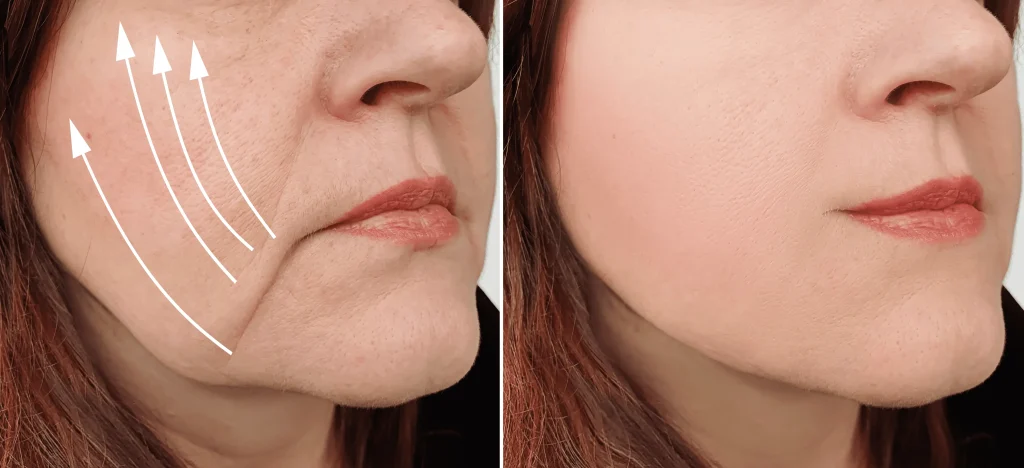
Importantly, sagging cheeks do not necessarily mean that the entire face needs surgical treatment. A detailed assessment can identify which specific changes are responsible for the patient’s concerns.
What Are the Treatment Options for Sagging Cheeks?
There is no single sagging cheeks treatment that is suitable for everyone. The best approach depends on the cause and severity of the changes.
Facial Fat Grafting
Facial fat grafting in Dubai can be considered when loss of facial volume is an important part of the problem. During fat grafting, a small amount of the patient’s own fat is harvested from another area of the body. After processing, carefully selected amounts of fat are transferred to areas of the face where additional volume is needed.
When appropriately performed, facial fat grafting can restore fullness to the cheeks and improve overall facial proportions.
One advantage of using the patient’s own tissue is that the restored volume can feel natural. However, fat retention varies between individuals, so the final result cannot always be predicted precisely.
Dermal Fillers
For selected patients with mild to moderate volume loss, dermal fillers can provide temporary improvement in cheek contour.
Fillers can be strategically placed to restore volume and improve facial proportions. An experienced practitioner should consider the entire face rather than simply adding volume directly to an area that appears hollow.
This approach can be particularly useful when a patient wants a minimally invasive option with little downtime.
Facelift Surgery
When cheek sagging is primarily related to significant tissue descent and skin laxity, a facelift surgery may offer a more comprehensive solution.
Modern facelift techniques are not simply about pulling the skin tighter. Depending on the technique and the patient’s anatomy, deeper facial tissues may also be repositioned to restore more youthful contours.
A facelift may therefore be considered when sagging cheeks occur alongside jowls, lower facial laxity, and other signs of facial aging.
Midface Rejuvenation
For patients whose primary concern is significant midface descent, a procedure specifically addressing the midface may sometimes be appropriate. The objective is to restore the position and contour of the cheek area while maintaining natural facial proportions.
Can Sagging Cheeks Be Treated Without Surgery?
In some cases, yes. Patients with early changes and relatively good skin elasticity may benefit from non-surgical approaches such as dermal fillers or selected skin-tightening treatments.
However, non-surgical procedures have limitations. They cannot reproduce the effects of surgical tissue repositioning when significant skin laxity or structural descent is present.
This is why the right treatment should be selected after assessing the underlying anatomy rather than simply choosing the least invasive procedure.
Who May Be a Candidate for Treatment?
A person considering sagging cheeks treatment may be suitable for facial rejuvenation if they:
- Are bothered by reduced cheek definition
- Notice volume loss or tissue descent
- Are generally healthy
- Have realistic expectations
- Understand the potential benefits and limitations of treatment
The ideal procedure varies significantly from patient to patient. Someone with primarily volume loss may require a very different approach from someone with substantial skin laxity.
Why a Personalized Assessment Matters
Facial rejuvenation should never be based solely on age or a single visible concern. During a consultation, an experienced plastic surgeon evaluates the relationship between the cheeks, temples, nose, lips, chin, jawline, and neck. Skin quality and facial volume are also considered. This holistic assessment helps determine whether the primary issue is:
- Loss of facial volume
- Skin laxity
- Tissue descent
- Bone structure
- A combination of several factors
With more than 40 years of experience, Dr. Mohan Rangaswamy approaches facial rejuvenation with a strong emphasis on individualized treatment planning. His goal is not to make every patient look the same, but to restore facial balance while preserving their distinctive features.
Patients researching the best cosmetic surgeon in Dubai should consider factors such as surgical experience, patient safety, treatment philosophy, and the ability to create proportionate, natural-looking results.
Recovery and Results
Recovery depends on the treatment selected. Non-surgical treatments such as dermal fillers generally involve relatively little downtime, although temporary swelling, redness, or bruising can occur.
Surgical procedures require a longer recovery period. Swelling and bruising are common during the early stages of healing and gradually improve as the tissues settle.
The final appearance develops progressively rather than immediately. Patients should follow their surgeon’s postoperative instructions and allow adequate time for healing before judging the final outcome.
Can Sagging Cheeks Be Prevented?
Facial aging cannot be completely prevented, but certain habits can support long-term skin health. Protecting the face from excessive sun exposure is particularly important. A consistent skincare routine, balanced nutrition, adequate hydration, avoiding smoking, and maintaining a relatively stable weight can also support healthy skin.
These measures cannot stop natural aging or completely prevent cheek sagging, but they may help maintain skin quality over time.
Frequently Asked Questions
What is the best treatment for sagging cheeks?
There is no universal best treatment. Facial fat grafting or fillers may be appropriate when volume loss is the main concern, while surgical rejuvenation may be more suitable when significant tissue descent and skin laxity are present.
Can facial exercises lift sagging cheeks?
Facial exercises may influence muscle activity, but they cannot reliably reposition significantly sagging skin or replace lost facial volume. Established structural changes generally require professional assessment and, when appropriate, aesthetic treatment.
Does losing weight make sagging cheeks worse?
Significant weight loss can reduce facial volume and may make previously subtle cheek laxity more noticeable. However, the effect varies considerably between individuals.
Are sagging cheeks the same as jowls?
Not exactly. Sagging cheeks primarily involve changes in the midface, while jowls refer to looseness or fullness developing along the lower jawline. The two concerns can occur together as facial tissues change with age.
Conclusion
Sagging cheeks are a common result of the complex changes that occur in the face over time. Loss of facial volume, reduced skin elasticity, tissue descent, genetics, and significant weight changes can all contribute to flatter or lower appearing cheeks.
Modern sagging cheeks treatment can range from minimally invasive volume restoration to surgical facial rejuvenation. The right choice depends on the individual’s anatomy and whether volume loss, skin laxity, or tissue descent is primarily responsible for the change.
Rather than treating a single line or isolated area, an experienced surgeon should assess the face as a whole. Restoring the cheeks in proportion to the surrounding facial structures can produce a more harmonious and natural-looking result.
With more than 40 years of experience in aesthetic and reconstructive surgery, Dr. Mohan Rangaswamy provides individualized treatment planning focused on facial harmony, safety, and natural-looking outcomes. His extensive experience makes him a trusted choice for patients looking for the best plastic surgeon in Dubai for facial rejuvenation.
Take the Next Step with an Expert Consultation
If you are concerned about sagging cheeks, an individualized assessment can help determine what is contributing to the change and which treatment options may be appropriate. Schedule a consultation with Dr. Mohan Rangaswamy to discuss your facial structure, goals, and potential sagging cheeks treatment options.